
Madrid, 5 November 2026.– On 25 October we put the clocks back one hour. In theory, we had 60 extra minutes to sleep. But what did we actually do with that extra time?
DuckDik, the Spanish wellness band brand, analysed 21,941 nights of sleep from 1,569 users in Spain, Italy, France, Germany and Portugal to find out how we reacted to the switch to winter time.
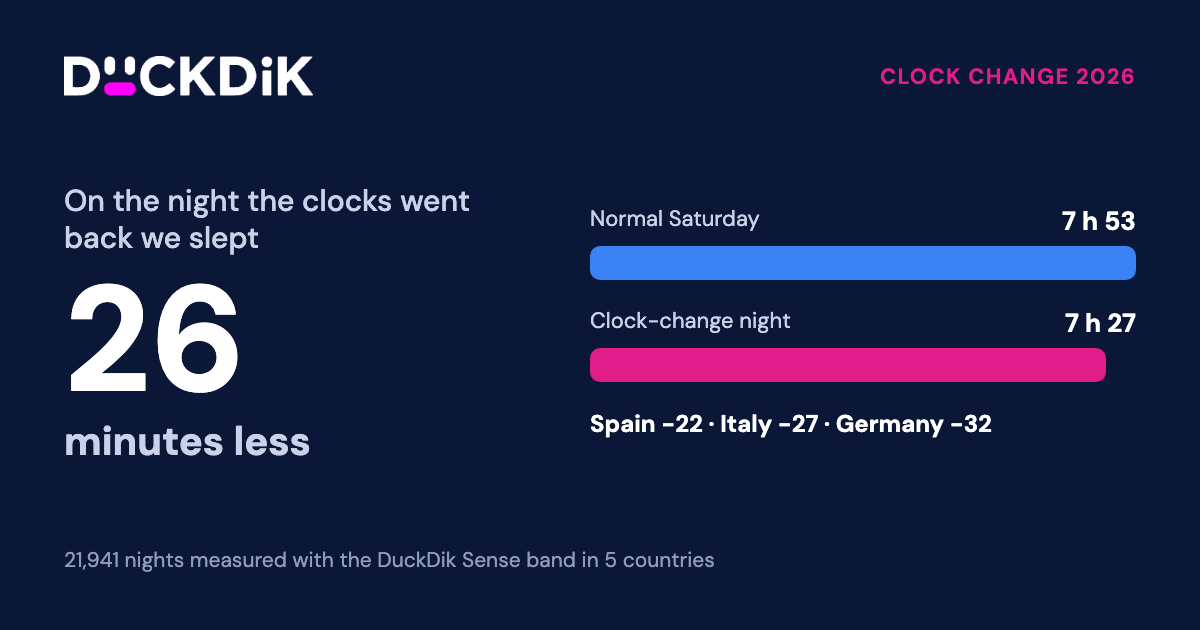
The main surprise: that night we slept 26 minutes less than usual. And although by Monday we had practically adjusted to the new clock, our bodies needed several more days to get back to their usual schedules.
“The clock change gave us an extra hour, but we didn't use it to sleep. The most surprising thing is that, although we adjust the clock in one night, our body needs several days to adapt. And all of this happens almost without us noticing,” says Alberto Lorente, co-founder and CEO of DuckDik.
An extra hour we didn't use
On the night of Saturday 24 to Sunday 25 October, the users analysed went to bed at practically their usual time: around 00:34.
However, they woke up earlier than would be expected if they had made use of the additional hour. The result was an average of 7 hours and 27 minutes of sleep, compared with 7 hours and 53 minutes on a normal Saturday.
The analysis also found signs of somewhat more fragmented rest:
- The share of nights with less than seven hours of sleep rose from 27% to 39%.
- Night-time awakenings increased from 1.5 to 1.7 per night.
- The time spent awake during the night went up from 18 to 22 minutes.
The trend was similar across age groups, from under-35s to over-50s.
By Monday, almost as if nothing had happened
Curiously, the impact on sleep duration practically disappeared once the working week began.
On Monday 26 October, participants slept an average of 7 hours and 13 minutes, just four minutes less than usual. They went to bed five minutes earlier and got up eight minutes earlier, by the new official time.
In other words, we quickly adapted our routines to the clock, even though our biological schedules were still adjusting.
Five days to get back to normal
Over the following days, users kept going to bed and waking up slightly earlier than usual. The gap narrowed gradually until it was close to normal schedules by the end of the week.
There is, however, an important finding: over the working week as a whole, no sleep was lost. Average duration was 7 hours and 17 minutes, exactly the same as in the reference period.
The clock change appears to have temporarily disrupted our schedules more than the total amount of rest.
Spain adapted faster than Germany
Although the overall trend was similar, the analysis found interesting differences between countries.
In Spain, the usual wake-up time was recovered in about three nights, although users kept going to bed roughly ten minutes earlier for part of the week.
Italy needed around four nights to recover its schedules.
Germany showed the longest adjustment: its users kept waking up about twelve minutes earlier than usual throughout the week and slept, on average, six minutes less.
France recorded hardly any change in sleep schedules, while in Portugal participants tended to go to bed earlier and sleep about nine minutes more.
Night owls took longer to adjust
The study also looked at whether the change affected early risers and people who usually go to bed late differently.
Early risers practically recovered their usual schedules from Monday, with differences of just one or two minutes.
Night owls, by contrast, kept a small lag throughout the week: they went to bed about eight minutes earlier and woke up six minutes earlier than usual.
Even so, both groups recorded a similar reduction in sleep on the night of the change.
What the clock change teaches us
The results show that changing the clock is instant, but changing our sleep habits takes a little longer.
They also point to a striking conclusion: having an extra hour available does not necessarily mean sleeping an extra hour. The body seems to follow its own routines, even when the clocks say otherwise.
And although the move to winter time caused small mismatches for several days, the study found no cumulative loss of sleep over the following week.
About the study
The analysis, carried out by DuckDik using data from its Sense bands, covers 21,941 nights from 1,569 people recorded between 10 October and 1 November 2026 in Spain, Italy, France, Germany and Portugal. The comparison for the night of the change includes 777 people with data for that night and for the previous Saturdays.
To reduce differences between people, each user's records were compared with their own habits before the clock change, using equivalent nights of the week.
Incomplete or inconsistent records were excluded, and specific checks were applied to correct the time differences produced during the early hours of the change.
This is an observational study based on DuckDik users, so its results describe the patterns of the sample analysed and not necessarily those of the entire European population. The full report, with the table by country and the methodology, is available at duckdik.com/en/prensa/.
About DuckDik
DuckDik is a Spanish wellness technology company headquartered in Madrid, co-founded by Alberto Lorente. It designs its own screen-free health wristbands, such as DuckDik Sense, manufactured by an industrial partner, and develops its own software: DuckDik Health, an app that turns body data into understandable insights and recommendations through an AI coach.
Available in ten languages and with no subscription, DuckDik Health accompanies the wristbands the company sells in Spain, Italy, France, Germany and Portugal through duckdik.com and Amazon.
Raw signals stay on the user's phone; what syncs to their account are already-summarized figures, hosted on servers within the European Union.
DuckDik is a wellness brand and not a medical device: it does not diagnose, treat or prevent any disease.
Press contact
Alberto Lorente
Co-founder and CEO of DuckDik
press@duckdik.com
Press room: duckdik.com/en/prensa/
Review units available for media. Alberto Lorente is available for interviews on television, radio, by phone or in person.