
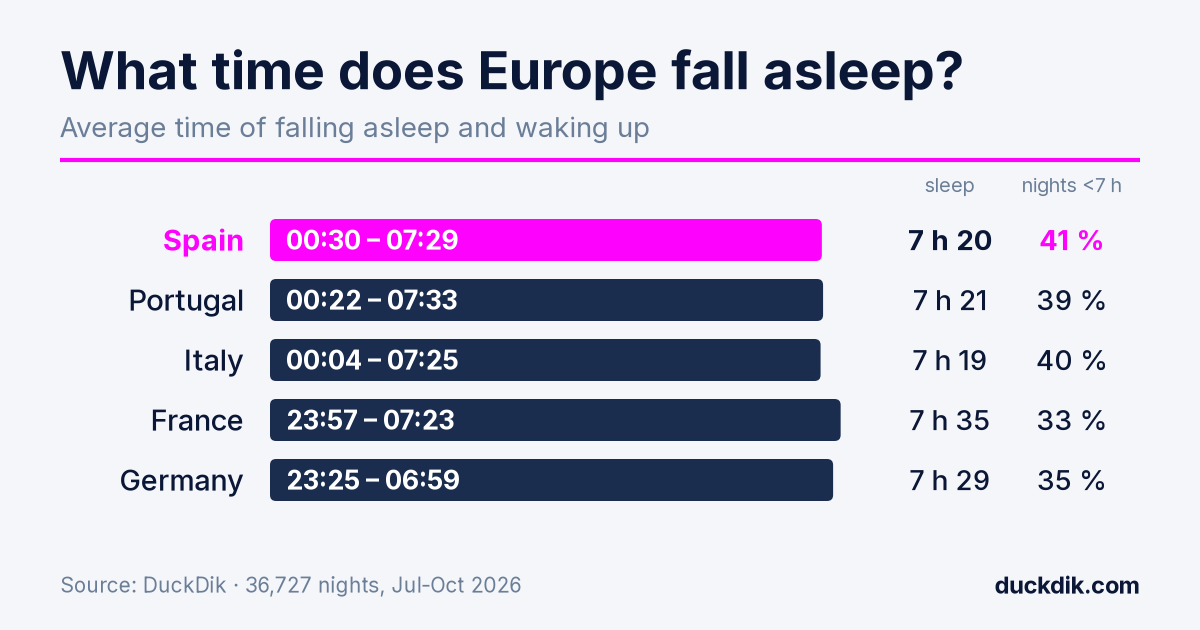
Spain falls asleep at 00:30, an hour later than Germany, and four in ten nights fall short of seven hours
- Data from 36,700 nights recorded by the DuckDik Sense wellness band in five countries, days before the clocks change on 25 October.
- Spanish users fall asleep on average at 00:30 and wake at 07:29. German users, at 23:25 and 06:59.
- On Saturday night, Spain's average time of falling asleep slips to one in the morning.
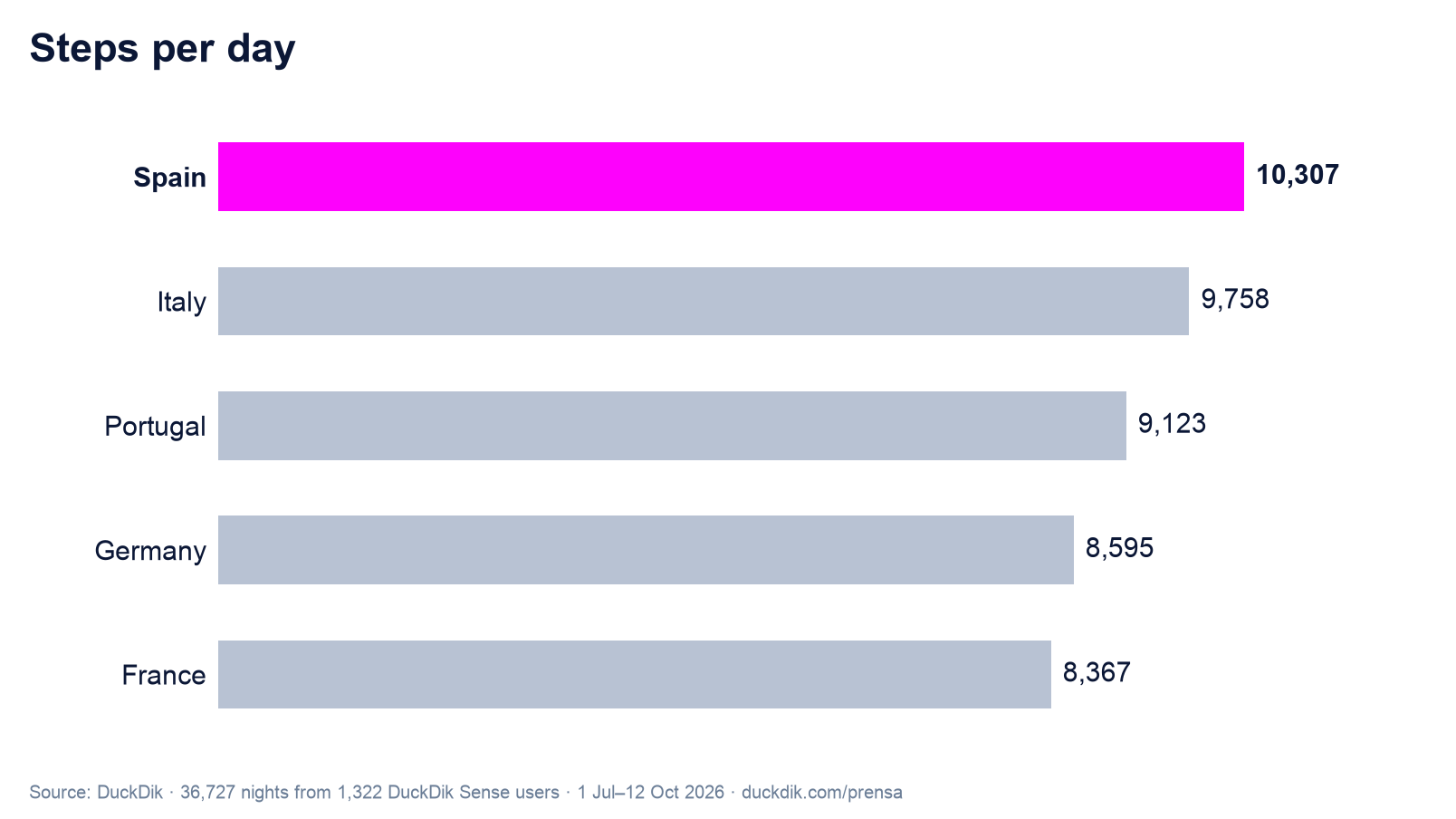
- In return, Spain walks the most: 10,300 steps a day, 20% more than Germany.
- The daily siesta is a myth: it appears on one day in nine, almost the same as in Germany.
Madrid, 14 October 2026.– On Sunday 25 October the clocks go back one hour and the yearly debate returns: is Spain living in the wrong time zone? DuckDik, the Spanish company that designs the screenless wellness band DuckDik Sense, has analysed its users' nights to answer with data rather than surveys: 36,727 nights from 1,322 people between July and October 2026, including 12,523 nights from 454 users in Spain.
Spain, the last to go to sleep
| Country | Falls asleep | Wakes up | Sleeps | Nights under 7 h | Steps per day |
|---|---|---|---|---|---|
| Spain | 00:30 | 07:29 | 7 h 20 | 41% | 10,307 |
| Portugal | 00:22 | 07:33 | 7 h 21 | 39% | 9,123 |
| Italy | 00:04 | 07:25 | 7 h 19 | 40% | 9,758 |
| France | 23:57 | 07:23 | 7 h 35 | 33% | 8,367 |
| Germany | 23:25 | 06:59 | 7 h 29 | 35% | 8,595 |
The Spanish user falls asleep about an hour later than the German one, but gets up only half an hour later. The numbers don't add up: they sleep around ten minutes less each night, and 17% of their nights don't even reach six hours.
The weekend, another time zone
From Sunday to Thursday, Spain falls asleep between 00:13 and 00:21. On Friday night it goes to sleep close to 00:50 and on Saturday, around one in the morning. One user in three shifts their sleep by an hour or more between weekdays and the weekend, what specialists call "social jet lag": on Monday the body is still on Saturday's schedule.
It is more marked among young people. Users aged 18 to 29 fall asleep on average at 00:52; those over 60, at 23:31. The over-60s sleep the most (7 h 39), although they are also the ones who wake up most often during the night.
More steps and less siesta than people think
Spain leads on movement: 10,307 steps a day on average, compared with 8,595 in Germany and 8,367 in France. And it debunks a cliché: only 11% of days include a siesta, compared with 9% in Germany or Italy.
Another finding: women sleep about 20 minutes more than men (7 h 40 versus 7 h 20) and fall asleep half an hour earlier.
What will happen on 25 October
"For years we have debated the clock change with opinions. Now we have data from thousands of real nights to see what actually happens," says Alberto Lorente, co-founder and CEO of DuckDik. "We Spaniards don't sleep much less than our neighbours, but we go to sleep later than anyone. In the week of the clock change we will measure, night by night, how long the body takes to adapt, and we will publish the result."
In the first week of November DuckDik will publish a second analysis with the real effect of the clock change on its users' sleep, country by country.
How the data were obtained
Aggregated, anonymous data from users of the DuckDik Health app with at least seven nights recorded between 1 July and 12 October 2026. Times are local to each country. Each user counts the same, however many nights they have. The country is the one where the user spends most time. It is not a representative sample of the population: these are people who have bought a wellness band, and 72% of those who state their sex are men. Sleep is estimated by the band from movement and pulse. The results were checked by repeating the calculation only with users who sync every day, with no manually corrected nights and no open support cases: the conclusions are the same, with differences of a few minutes. DuckDik Sense is a wellness product, not a medical device.
Charts and data to publish
Free to use with credit: DuckDik.
About DuckDik
DuckDik is a Spanish wellness technology company headquartered in Madrid, co-founded by Alberto Lorente. It designs its own screen-free health wristbands, such as DuckDik Sense, manufactured by an industrial partner, and develops its own software: DuckDik Health, an app that turns body data into understandable insights and recommendations through an AI coach.
Available in ten languages and with no subscription, DuckDik Health accompanies the wristbands the company sells in Spain, Italy, France, Germany and Portugal through duckdik.com and Amazon.
Raw signals stay on the user's phone; what syncs to their account are already-summarized figures, hosted on servers within the European Union.
DuckDik is a wellness brand and not a medical device: it does not diagnose, treat or prevent any disease.
Press contact
Alberto Lorente
Co-founder and CEO of DuckDik
press@duckdik.com
Press room: duckdik.com/en/prensa/
Review units available for media. Alberto Lorente is available for interviews on television, radio, by phone or in person.