What even their creators don't understand
There's something about artificial intelligence that I find especially fascinating. It isn't simply that it can answer questions, write texts or solve problems. It's that it is developing capabilities its own creators hadn't fully anticipated.
Yesterday I listened to an interview on Lenny's Podcast with Emmanuel Ameisen, a researcher at Anthropic who specialises in understanding what happens inside large artificial intelligence models.
The surprising thing is that their own creators don't fully understand how they work inside.
We know how to build and train them, but we don't always understand how they reach certain conclusions or why they develop capabilities that nobody has explicitly taught them.
Systems we grow, not programs
Ameisen explains that these models are more like systems we grow through learning than traditional programs in which we have defined every behaviour.
Researchers are discovering that the models build internal representations of concepts, establish relationships and develop strategies that nobody has programmed directly.
All of this happens through mathematical operations. Not because the models invent new mathematical laws, but because training organises billions of parameters until it produces mechanisms that we are still trying to understand.
It's an extraordinary situation: we have created these systems, and now we need to investigate them to discover how they have learned to reason.
A question that goes beyond AI
And while I was listening to the interview, a question came to me that goes well beyond artificial intelligence.
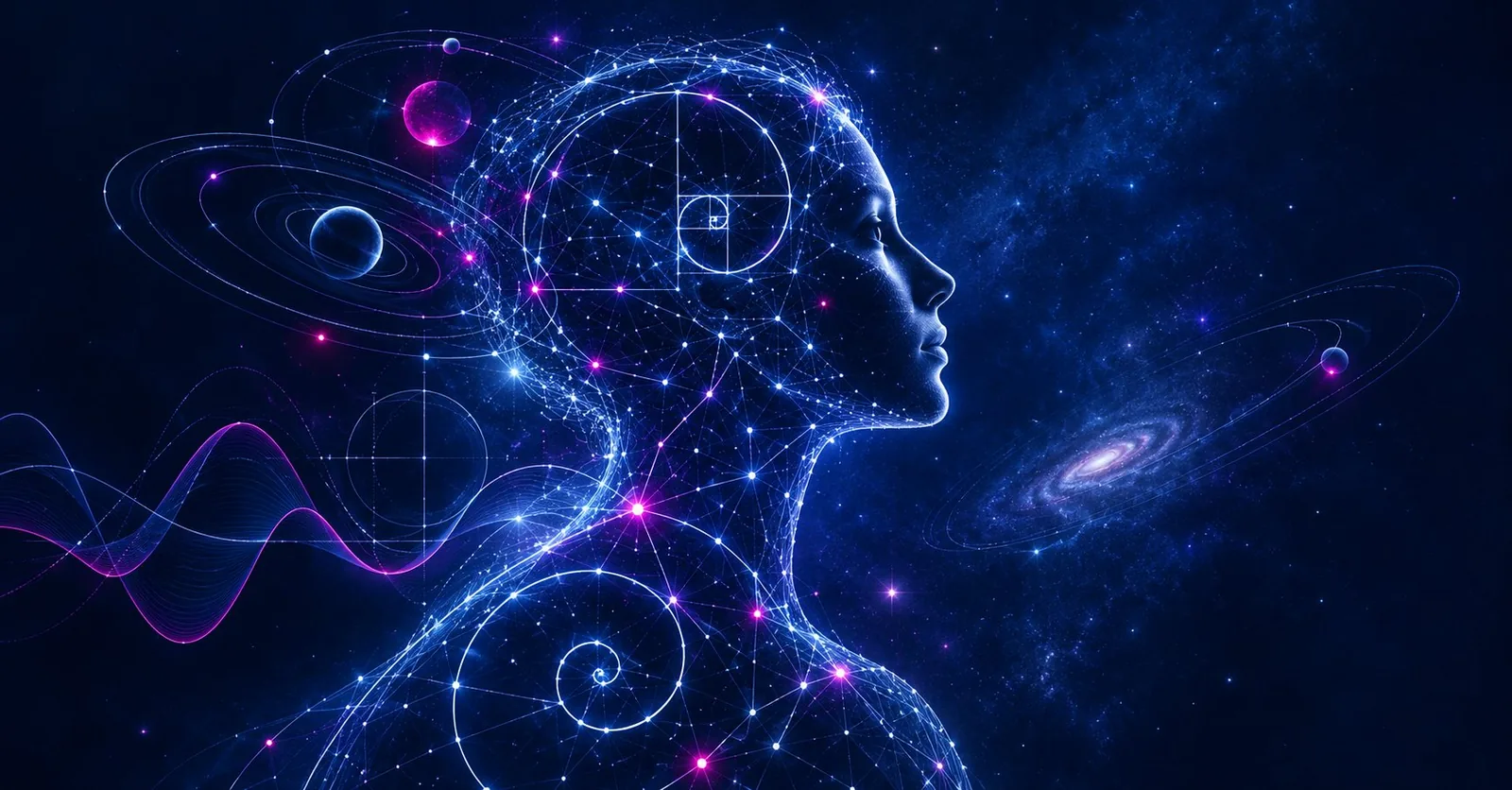
What if mathematics weren't simply a tool we discovered to understand the world? What if we ourselves were mathematics?
What if we've got it backwards?
We have always thought that humans discovered mathematics to explain the universe. But the relationships it describes existed long before us.
The planets followed their orbits before Newton. Atoms interacted before chemistry existed. And our brains work through physical processes that also obey those same laws.
A language, a face, a brain
Think of something as everyday as learning a language. Our brain discovers patterns, establishes relationships and ends up building sentences it has never heard. Curiously, artificial intelligence models do something similar through completely different mechanisms, based on mathematical operations.
Or think of our ability to recognise one face among thousands. We do it almost instantly, without being able to explain how. Today an artificial neural network can develop a similar ability by learning relationships across enormous amounts of data.
That doesn't mean our brains work the same way as an artificial intelligence. But it does raise something fascinating: perhaps intelligence depends less on the material we are made of than on the relationships established between its components.
And if those relationships are mathematical, what are we really?
A hypothesis, not a certainty
Perhaps mathematics isn't simply a language we invented to describe reality, but part of the structure of reality itself.
This hasn't been proven. That something can be described mathematically doesn't necessarily mean it is mathematics. But what we are observing with artificial intelligence makes it worth considering.
Because there is something extraordinary about a set of mathematical operations being able to learn, reason and develop capabilities that not even its creators fully understand.
Mathematics discovering itself
What if we are another example of that same phenomenon, one that emerged through millions of years of biological evolution instead of artificial training?
Perhaps we are not beings who discovered mathematics from the outside.
Perhaps we are a part of the universe that, organised in a particular way, has acquired the ability to understand the rules that made it possible.
And perhaps we haven't discovered mathematics. Perhaps we are mathematics discovering itself.
DuckDik is a wellness product. It is not a medical device, it does not diagnose and it does not replace advice from a healthcare professional. If you have symptoms, see your doctor.