Updated 14 October: wake-up times and weekend data corrected.
Spain falls asleep at 00:30, the latest of five countries
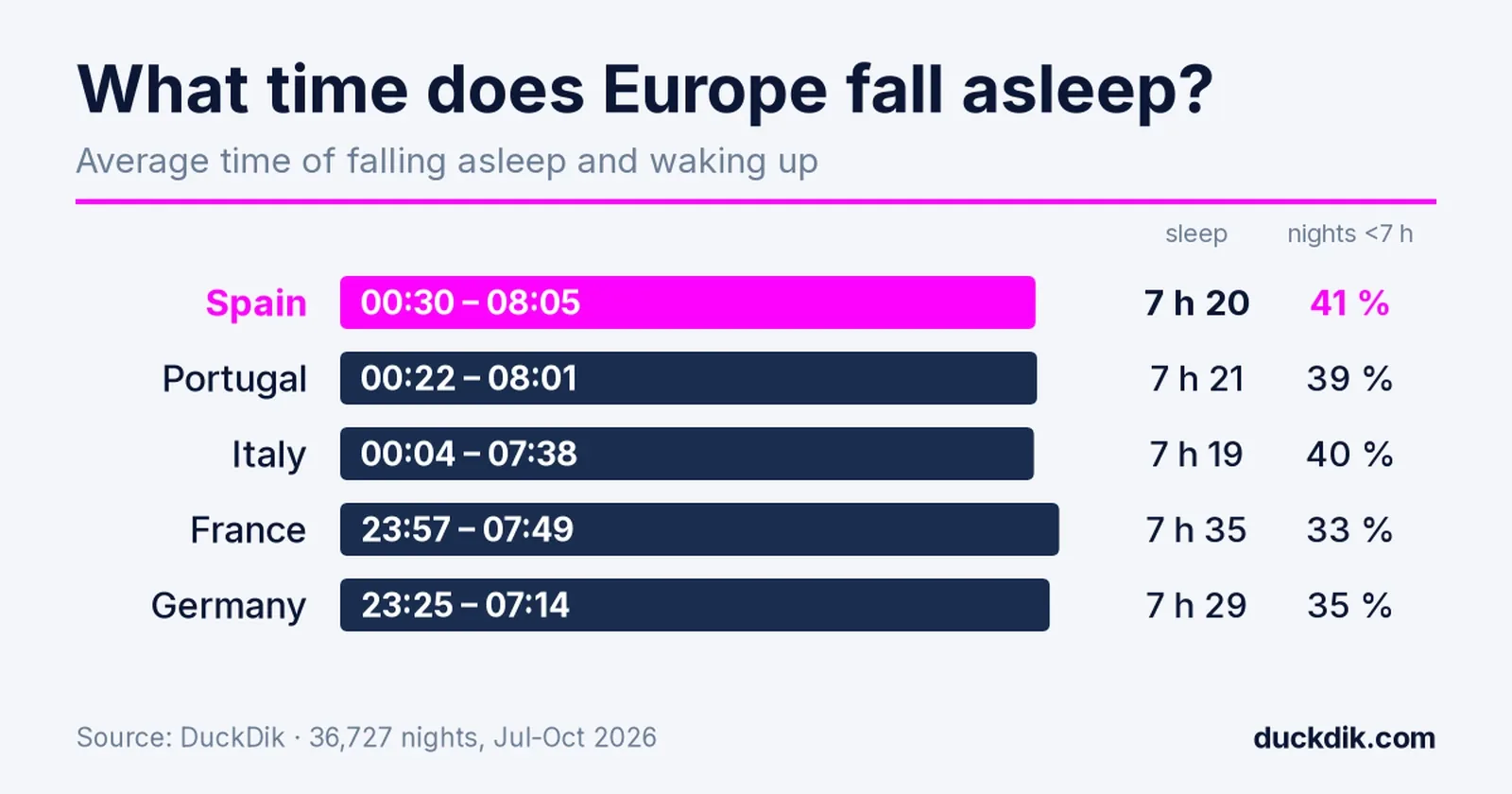
On Sunday 25 October the clocks go back one hour and the yearly question returns: does Spain live on the wrong schedule? Data from 36,727 nights recorded by wearables between July and October 2026 give a concrete answer. In Spain the average time of falling asleep is 00:30, around one hour later than in Germany. Wake-up time, on the other hand, is delayed somewhat less, by about 50 minutes. The result: four out of ten nights in Spain last less than seven hours.
The data come from 1,322 users of the DuckDik Sense wristband in Spain, Portugal, Italy, France and Germany. Of them, 454 live in Spain and account for 12,523 nights.
| Country | Falls asleep | Wakes up | Actual sleep | Nights under 7 h | Steps per day |
|---|---|---|---|---|---|
| Spain | 00:30 | 08:05 | 7 h 20 | 41 % | 10,307 |
| Portugal | 00:22 | 08:01 | 7 h 21 | 39 % | 9,123 |
| Italy | 00:04 | 07:38 | 7 h 19 | 40 % | 9,758 |
| France | 23:57 | 07:49 | 7 h 35 | 33 % | 8,367 |
| Germany | 23:25 | 07:14 | 7 h 29 | 35 % | 8,595 |
Mind the maths: bedtime and wake-up time mark the time spent in bed, while actual sleep leaves out the minutes it takes to drop off and the awakenings during the night, which is why it comes out a bit lower.
Why the time you fall asleep matters, not just how many hours
The difference between countries lies less in how much people sleep than in when. A Spanish user sleeps about ten minutes less than a German one, a small difference. But they do it with their sleep shifted one hour towards the small hours.
That has a practical consequence. Wake-up time is set by work and school, and it shifts less than bedtime. Whoever falls asleep late has less margin: any night that runs a little long ends up too short. That is why in Spain 17 % of nights do not even reach six hours.
The weekend, another time zone
From Sunday to Thursday, the average time of falling asleep in Spain is between 00:13 and 00:21. On Friday night it moves to around 00:50, and on Saturday to one in the morning.
Four in ten users shift their sleep by one hour or more between weekdays and the weekend. Specialists call it "social jet lag": on Monday morning the body is still on Saturday's schedule, just as after a flight across time zones.
Young people fall asleep latest
Between 18 and 29, the average time of falling asleep is 00:52. From 60 onwards, 23:31. People over 60 also sleep the most (7 h 39), although they wake up more often during the night.
Women sleep about 20 minutes more
Women sleep 7 h 40 on average and men 7 h 20. Women also fall asleep about half an hour earlier.
Spain walks more and naps less than people think
Two figures that break stereotypes:
- Spain is the country that walks the most of the five: 10,307 steps a day on average, 20 % more than Germany (8,595) and 23 % more than France (8,367).
- The daily siesta is a myth. Only 11 % of days include a nap. In Germany and Italy it is 9 %.
What will happen with the clock change on 25 October
Turning the clock back one hour means, in theory, one more hour of sleep that night. In practice, the body does not change schedule in a day: for several days it tends to fall asleep and wake up at the usual time.
"We have spent years debating the clock change with opinions. Now we have data from thousands of real nights to see what really happens," explains Alberto Lorente, co-founder and CEO of DuckDik. "We Spaniards do not sleep much less than our neighbours, but we go to sleep later than anyone. In the week of the clock change we will measure, night by night, how long the body takes to adapt, and we will publish the result."
The second analysis, with the real effect of the clock change by country, will be published in the first week of November.
How the data were obtained
- Aggregated, anonymous data from users of the DuckDik Health app with at least seven nights recorded between 1 July and 12 October 2026.
- Times are local in each country. The country is the one where the user spends the most time.
- Every user counts the same, whether they have more or fewer nights recorded.
- It is not a representative sample of the population: these are people who have bought a wellness wristband, and 72 % of those who state their sex are men.
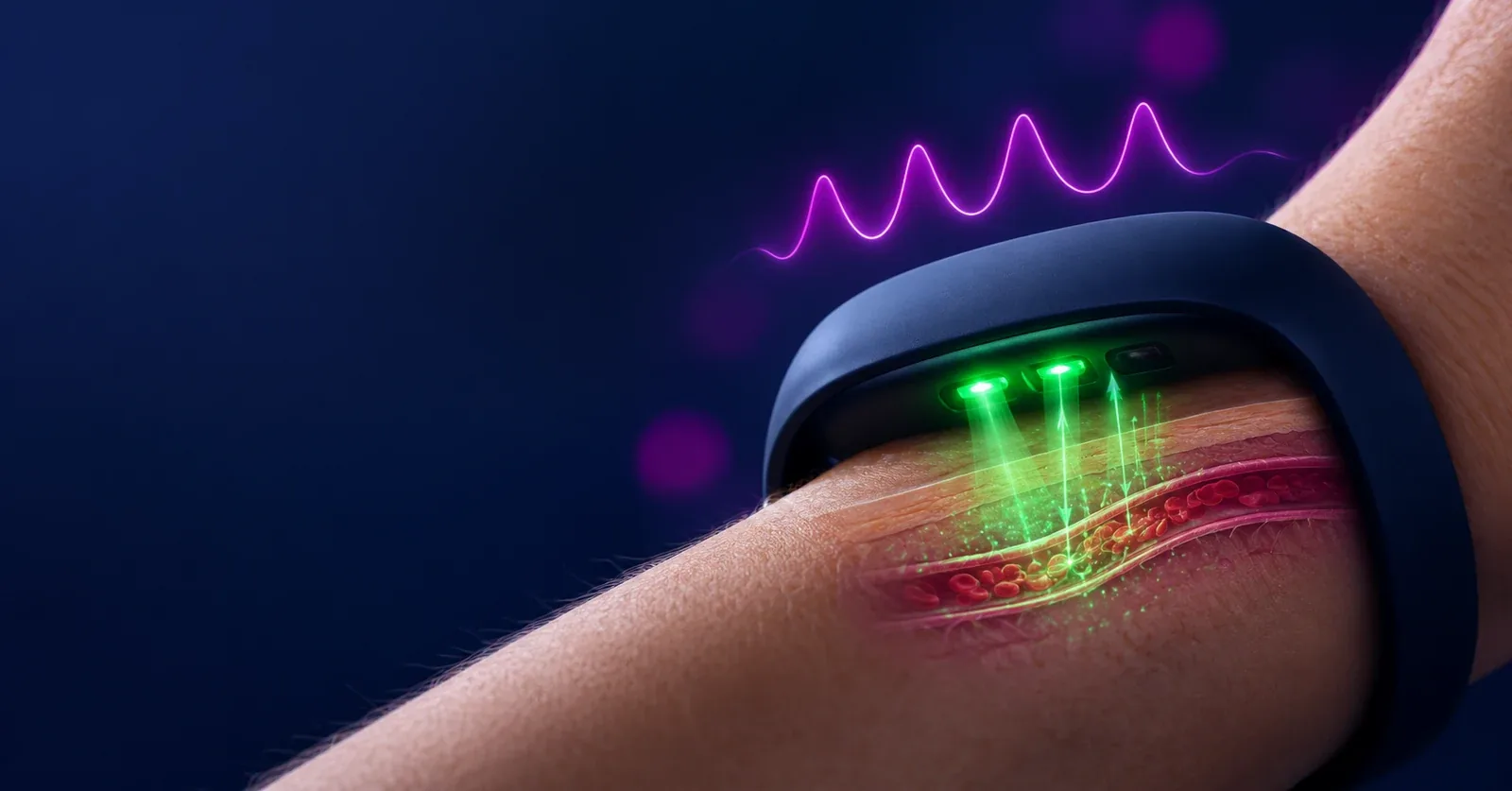
- Sleep is estimated by the wristband from movement and pulse.
- The calculation was repeated only with users who sync daily, without manually corrected nights and without open customer-service tickets. The conclusions are the same, with differences of a few minutes.
The full press release, with charts and the country table to download, is in the DuckDik press room.
Frequently asked questions
What time do Spaniards fall asleep?
According to 12,523 nights from 454 users in Spain, the average time of falling asleep is 00:30 and of waking up 08:05.
Do Spaniards sleep less than Germans?
Only about ten minutes less per night (7 h 20 versus 7 h 29). The big difference is the schedule: Spain falls asleep around one hour later.
What is social jet lag?
It is the gap between the sleep schedule on weekdays and at the weekend. Four in ten users shift their sleep by one hour or more.
Is it true that people in Spain take a siesta every day?
No. A nap appears on 11 % of days, almost the same as in Germany or Italy (9 %).
When is the October 2026 clock change?
In the early hours of Sunday 25 October 2026: at 03:00 it will be 02:00.
DuckDik is a wellness product. It is not a medical device, it does not diagnose and it does not replace advice from a healthcare professional. If you have symptoms, see your doctor.