An extra hour… and 26 fewer minutes of sleep
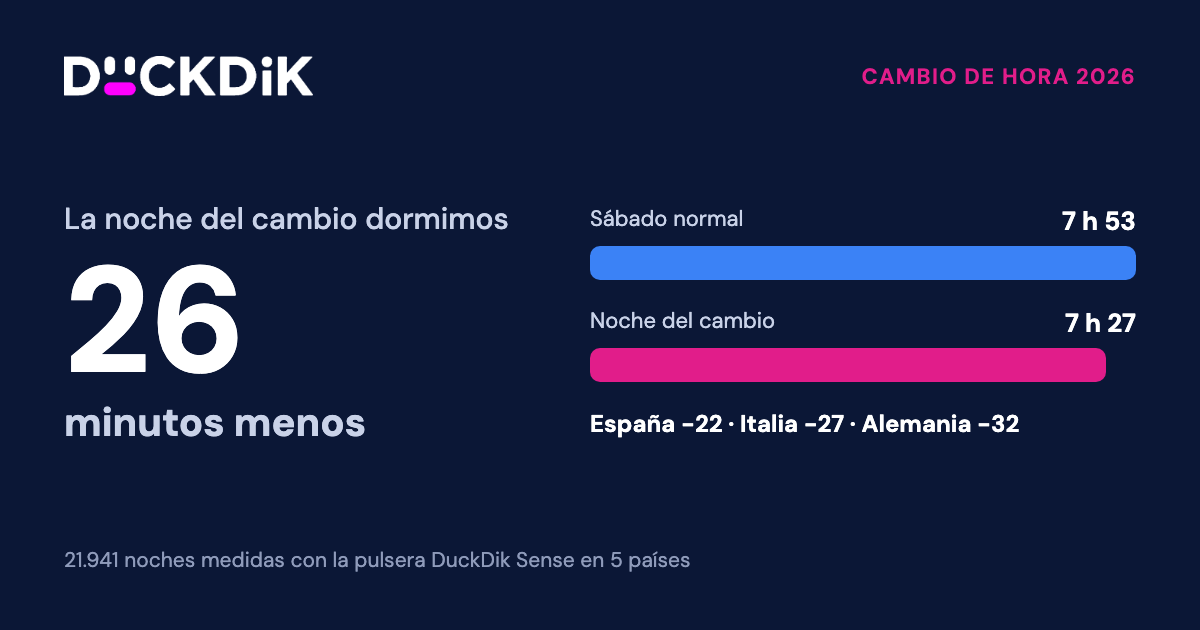
On Sunday 25 October we put the clocks back and, in theory, gained 60 minutes of sleep. What did we actually do with that gift? A DuckDik analysis of 21,941 nights from 1,569 people in Spain, Italy, France, Germany and Portugal, between 10 October and 1 November 2026, gives a counter-intuitive answer: on the night of the change we slept 26 minutes less than on a normal Saturday.
It is not a clock error. It is what happens when the body and the calendar are not in sync.
The changeover night, without the 60-minute bonus
In the early hours of Saturday 24 to Sunday 25, people wearing the DuckDik Sense wristband went to bed at roughly the usual time: around 00:34. Had they used the extra hour, they would have slept more. Instead they woke earlier than you would expect, and the average result was 7 hours 27 minutes of sleep, versus 7 hours 53 minutes on a typical Saturday.
The comparison used 777 people with data that night and on previous Saturdays, each measured against their own habits. Rest was also a little more fragmented:
- Nights under seven hours of sleep rose from 27% to 39%.
- Night awakenings rose from 1.5 to 1.7 per night.
- Time spent awake during the night rose from 18 to 22 minutes.
In short: we were given an hour and, on average, we did not spend it sleeping.
Monday, almost as if nothing had happened
What stands out is how fast “official” sleep recovers. On Monday 26 average duration was 7 hours 13 minutes, only four minutes below usual. People went to bed five minutes earlier and got up eight minutes earlier, on the new clock.
In other words: we adjusted our routines to the clock in a day. The body, meanwhile, was still catching up.
The working week did not lose accumulated sleep
Over the following days, many users kept going to bed and waking a little earlier than usual. The gap closed gradually. But one key figure stands out: across the working week average duration was 7 hours 17 minutes, the same as in the reference period. There was no accumulated sleep debt. The change mainly moved schedules, not total rest.
Spain adapts sooner; Germany takes longer
The overall trend was similar, but the return to normal was not the same everywhere:
- In Spain, the usual wake-up time returned in about three nights, though people still went to bed about ten minutes earlier for part of the week.
- Italy needed around four nights.
- Germany showed the longest adjustment: waking about twelve minutes earlier all week and sleeping, on average, six minutes less.
- In France there were barely any schedule changes.
- In Portugal, people tended to go to bed earlier and sleep about nine minutes more.
Early birds and night owls do not react the same way
Early birds were almost back to normal by Monday, with gaps of only one or two minutes from their usual pattern. Night owls, by contrast, carried a small lag all week: they went to bed about eight minutes earlier and woke about six minutes earlier. Both groups, though, lost a similar amount of sleep on the changeover night.
“The clock change gave us an extra hour, but we did not use it to sleep. The most surprising thing is that, although we reset the clock in one night, our body needs several days to adapt. And almost all of this happens without us noticing,” says Alberto Lorente, co-founder and CEO of DuckDik.
How it was measured
The study is observational: 21,941 nights from 1,569 DuckDik Sense users in ES, IT, FR, DE and PT, from 10 October to 1 November 2026. Each person was compared with their own prior habits on equivalent weeknights. Incomplete or inconsistent records were excluded, and the midnight clock shift was corrected. The results describe this sample, not necessarily the whole European population.
The full press release, with the country table and methodology, is in the DuckDik press room.
Alberto Lorente
Frequently asked questions
Did we sleep more on the October 2026 clock-change night?
No. According to DuckDik’s analysis, that night we slept 26 minutes less on average than a normal Saturday: 7 h 27 versus 7 h 53.
How long did it take to adapt to winter time?
Several days. Spain recovered its usual wake time in about three nights; Italy in about four; Germany needed longer across the week.
Was there accumulated sleep loss in the working week?
No. Average duration across the working week was 7 h 17, the same as in the reference period.
Who adapts sooner, early birds or night owls?
Early birds were almost back to normal by Monday. Night owls kept a small lag all week.
DuckDik is a wellness product. It is not a medical device, it does not diagnose and it does not replace advice from a healthcare professional. If you have symptoms, see your doctor.