While you sleep, your wrist takes notes
Every morning the app tells you how much deep sleep and how much REM you got. Curious, because the band can't see your brain or watch your eyes. So how does it know? The answer mixes indirect clues, statistics and a healthy dose of humility.
How a sleep lab does it
To classify sleep "for real" there is polysomnography. The person sleeps with sensors that record brain waves (the electroencephalogram, or EEG), eye movements and muscle tension. Afterwards, a technician reviews the night in 30-second chunks and gives each one a label: wake, N1, N2, N3 or REM, following the rules of the American Academy of Sleep Medicine (AASM).
N1 and N2 make up light sleep. N3 is deep sleep, with slow, wide brain waves. In REM the brain becomes very active, the eyes move quickly and the muscles go almost completely slack.
Fun fact: not even the experts always agree. In an AASM programme where more than 2,500 technicians scored the same recordings, average agreement was 82.6%, dropping to 67% for deep sleep.
The clues a band reads
Without EEG, the band plays detective with what it can pick up from the wrist:
- Movement. The accelerometer detects whether you move. It's the best clue for telling sleep from wake, but it says little about the stage.
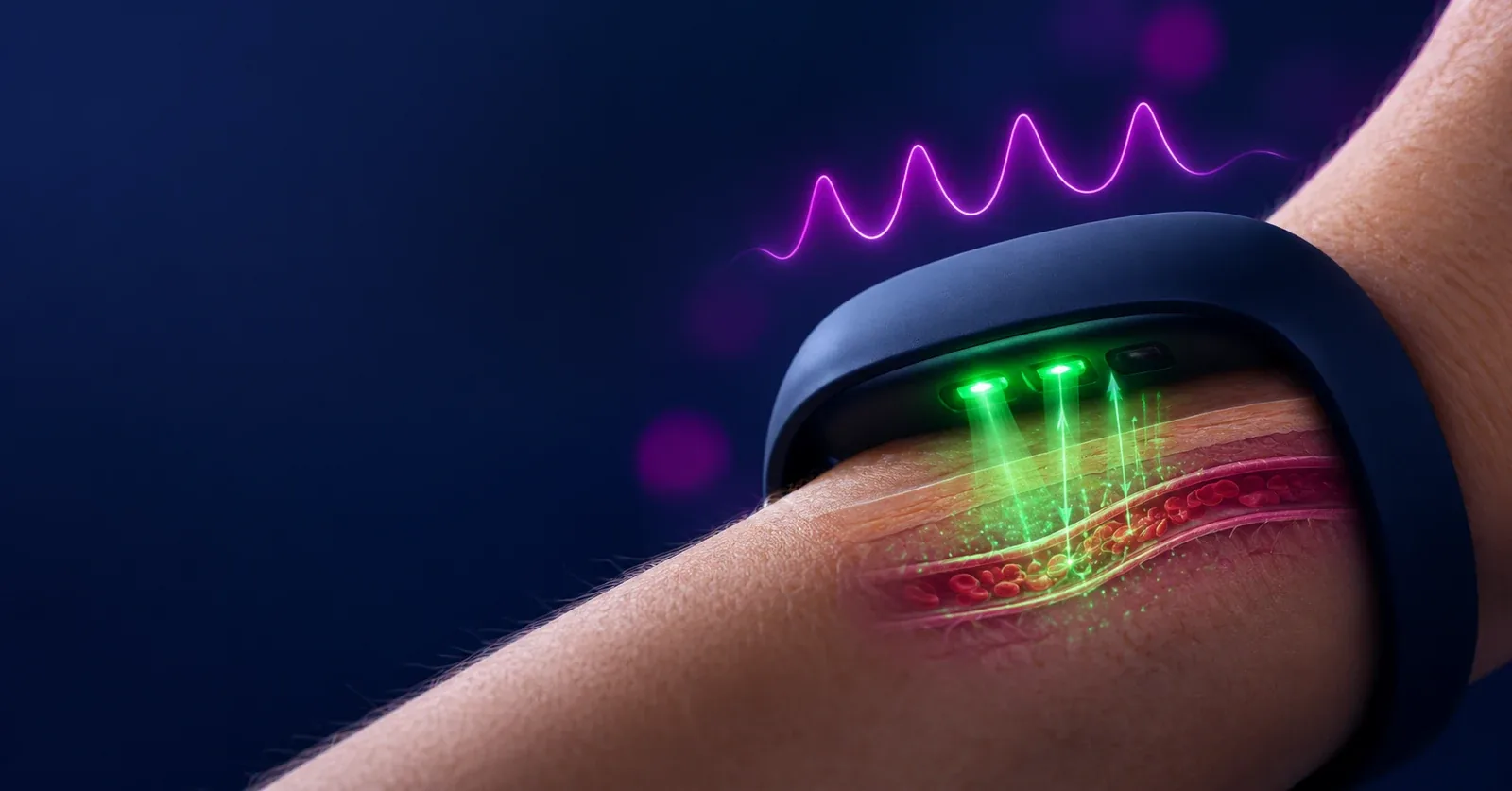
- Pulse. An optical sensor follows your heartbeat. In deep sleep the pulse drops and becomes regular; in REM it gets restless.
- Heart rate variability (HRV). These are the tiny differences in time between one beat and the next. They reflect the tug of war between the nervous system's "brake" and "accelerator".
- Breathing. Breathing leaves a mark on the pulse: when you inhale the heart speeds up a little and when you exhale it slows down. From that, the breathing rhythm can be inferred: calmer in deep sleep, more irregular in REM.
- The time. REM is more common in the second half of the night.
Slicing the night into 30 seconds
With those signals, the algorithm imitates the technician: it splits the night into chunks of about 30 seconds (eight hours gives you 960). For each chunk it calculates a handful of numbers, and a model trained on nights recorded at the same time with polysomnography decides which stage is most likely: awake, light, deep or REM.
That's why bands talk about "light" sleep instead of N1 and N2: without brain waves, telling those two apart is almost impossible.
How close is it to the lab?
It's an estimate, not a polysomnography. The studies say so:
- Telling asleep from awake works well. In a 2021 study of seven consumer devices, all of them recognised at least 93% of the sleep chunks, but only between 18% and 54% of the time spent awake.
- Stages are harder. With 106 people and 440 nights, a model that used movement alone got the stage right in 57% of chunks; adding pulse, variability and time of night raised it to 79%.
- Devices differ a lot. A 2023 study of 11 devices found agreement with the lab ranging from "moderate" to barely "slight".
- Restless nights are the hardest. With fragmented sleep, they all make more mistakes.
In perspective: if human technicians agree around 83% of the time, an algorithm that can't see the brain reaching 79% is remarkable. But every single night has its margin of error.
What to do with the number
What matters is the trend. If one day shows 40 minutes of deep sleep and the next an hour and ten, it could be your night or the algorithm. But if over several weeks you see your deep sleep drop whenever you have a late dinner, that is useful information.
- Compare weekly or monthly averages, not single days.
- Look first at the most reliable data: what time you fall asleep, how long you sleep and how regular you are.
- Use the stages as a clue to ask yourself questions, not as a verdict.
- If you sleep badly over a long period, the conversation is with a healthcare professional, not with the app.
In a screenless band like the DuckDik Sense, which also estimates sleep stages, the interesting part comes when you look at several weeks in a row.
Frequently asked questions
Can a band really know which sleep stage I'm in?
It estimates it. It doesn't measure brain waves: it combines movement, pulse, heart rate variability (HRV) and breathing inferred from the pulse to work out the most likely stage.
Why is the night split into 30-second chunks?
It's the sleep lab standard: AASM rules score the night in 30-second epochs. Band algorithms copy that format so they can be compared with the lab.
How closely do wearables agree with the lab?
They tell sleep from wake well, but stages are harder. In a study of 440 nights, a movement-only model got the stage right in 57% of chunks, and 79% with pulse, HRV and time of night. Human technicians agree around 83% of the time.
Should I worry if I get little deep sleep one night?
A single night says little. Look at weekly or monthly averages. If you sleep badly over a long period, talk to a healthcare professional.
- AASM Manual for the Scoring of Sleep and Associated Events (American Academy of Sleep Medicine)
- Rosenberg & Van Hout (2013). The AASM Inter-scorer Reliability Program: Sleep Stage Scoring. J Clin Sleep Med
- Chinoy et al. (2021). Performance of seven consumer sleep-tracking devices compared with polysomnography. Sleep
- Altini & Kinnunen (2021). The Promise of Sleep: A Multi-Sensor Approach for Accurate Sleep Stage Detection Using the Oura Ring. Sensors
- Lee et al. (2023). Accuracy of 11 Wearable, Nearable, and Airable Consumer Sleep Trackers: Prospective Multicenter Validation Study. JMIR mHealth uHealth
DuckDik is a wellness product. It is not a medical device, it does not diagnose and it does not replace advice from a healthcare professional. If you have symptoms, see your doctor.