A heart that is not a metronome
Put two fingers on your wrist and count. Your heart seems to beat with the regularity of a clock, but it doesn't. If we measured the exact time between one beat and the next, we would see it changing constantly: 850 milliseconds, then 910, then 870… Those differences, just a few hundredths of a second, have a name: heart rate variability, or HRV. And they are the main clue a wristband uses to tell whether you are under strain.
The curious thing is that a relaxed heart is more irregular, not less. When you breathe in, your pulse speeds up a little; when you breathe out, it slows down. This swing, called respiratory sinus arrhythmia, is normal and a sign of a well-tuned system.
The accelerator and the brake
Who pulls those strings? The autonomic nervous system, the part that runs on autopilot. It has two branches that work like a car's accelerator and brake.
The sympathetic system is the accelerator: it gets the body ready to act in the face of a threat, an exam or an urgent email. It raises the pulse and makes it more even, like a drum keeping time. The parasympathetic system, which travels mainly along the vagus nerve, is the brake: it takes over when we rest, digest or sleep, and lets the rhythm fluctuate freely.
When we keep our foot on the accelerator for a long time, variability drops: that is the footprint of stress that can be read from the outside.
How the light on your wrist picks it up
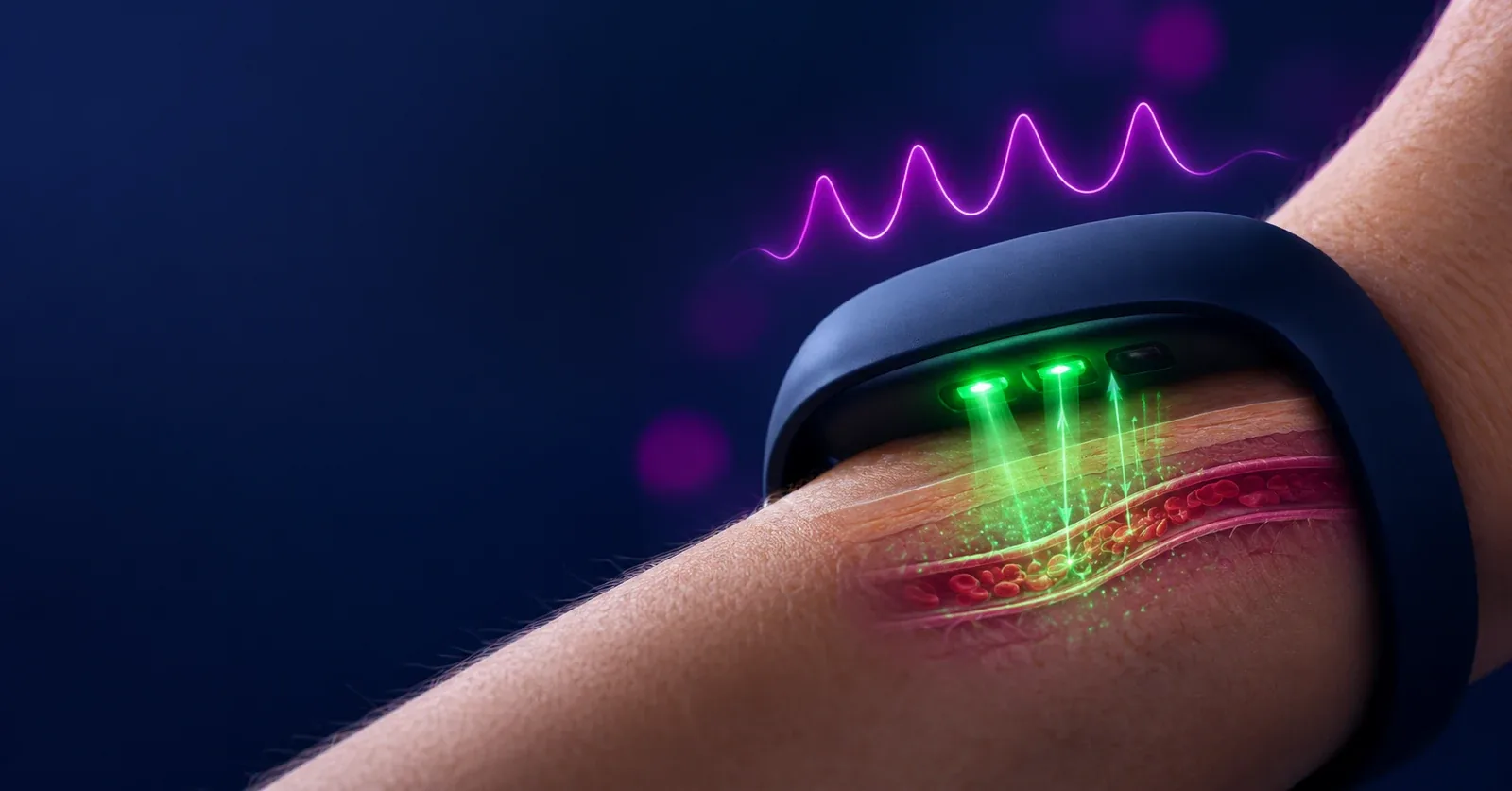
The wristband has no chest electrodes: it shines small LEDs onto the skin and measures how much light comes back. With every heartbeat, the vessels fill with a little more blood and absorb more light. This draws a wave, and the algorithm finds the peak of each pulse to work out the time between one and the next.
From those intervals it calculates, for example, RMSSD, which compares each interval with the next one and sums up how much they change on average. A high value usually means the brake is on; a low one, that the accelerator is in charge.
The big enemy: moving
Here is the catch. If you walk, climb stairs or simply gesture while you talk, your pulse rises from pure physical effort and variability falls even if you are perfectly calm.
That is why the wristband also has an accelerometer, the same kind of sensor that counts steps. When it detects that you are moving, it discards or corrects those stretches. The stress figure makes most sense in still moments: sitting at the computer, on the sofa or in a meeting.
Your number is yours alone
There is no "correct" HRV number for everyone. It changes with age, genetics, fitness and even the time of day.
That is why algorithms don't compare you with an ideal, but with yourself. During the first days, the wristband learns what your heart looks like at rest, especially at night. From then on, the stress figure shows how far you are from your own normal. It is a relative scale, more like a personal thermometer than an exam grade.
What the wristband cannot know
One thing, though: the heart does not tell emotions apart. Nerves before speaking in public and the thrill of watching your team score can leave a very similar footprint. The wristband measures how activated your body is, not whether you feel good or bad.
Things we don't usually link to stress also play a part: an afternoon coffee, a heavy dinner, a glass of wine, a cold coming on or a bad night. They all press the accelerator a little. So when the figure is high for no obvious reason, the explanation is sometimes on your plate or on your pillow.
Read the curve, not the moment
A single reading says little. What matters is the pattern: whether your figures always rise on Monday mornings, or whether a walk after lunch brings your pulse back to calm.
Want to try it? Sit down and breathe slowly for two minutes: in for four seconds, out for six. You are pressing the brake on purpose, and the curve often shows it within minutes.
Frequently asked questions
How does a wristband measure stress?
It analyses heart rate variability (HRV), the small time differences between heartbeats, and compares it with your own resting baseline.
Why does my stress level rise when I feel calm?
Movement, coffee, a heavy dinner, alcohol, a cold or a bad night also lower HRV. And the heart can’t tell nerves from excitement.
Is there a normal HRV value for everyone?
No. It depends on age, genetics, fitness and time of day. What helps is comparing yourself with yourself and watching trends.
DuckDik is a wellness product. It is not a medical device, it does not diagnose and it does not replace advice from a healthcare professional. If you have symptoms, see your doctor.