
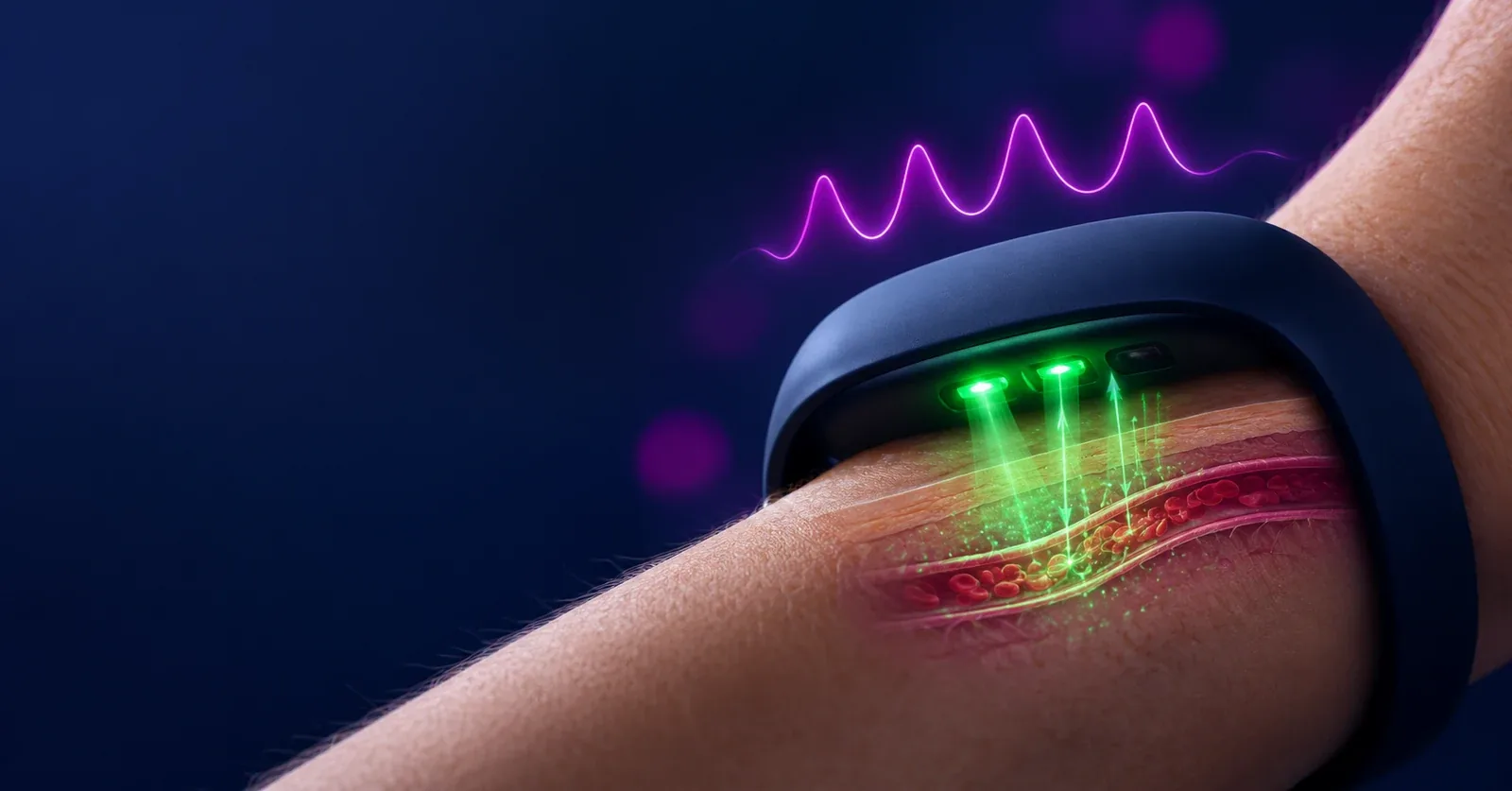
A tiny torch and an eye that counts reflections
A wristband knows your pulse using only light: it shines a small green light into your skin, a sensor measures how much light bounces back and, because blood absorbs light, every heartbeat changes that amount very slightly. By counting those rises and falls per minute, the device works out your heart rate. The technique is called photoplethysmography, although almost everyone knows it by its initials: PPG.
Turn an activity tracker over and you will see a few little lights (LEDs) and one or two dark dots: these are photodiodes, a kind of electronic eye that turns light into an electrical signal. No needles, no electrodes: just light going into the skin and light coming back out.
Why can light "see" blood?
When light hits your wrist, it meets skin, fat, bone and blood vessels. Almost all of that is constant: your bone does not change size from one second to the next. Blood, however, moves. With every heartbeat a small wave arrives that slightly swells arteries and capillaries. Because haemoglobin (the protein that gives blood its red colour) absorbs green light very well, more blood means less light gets back to the sensor.
The result is a huge, almost fixed signal with a tiny ripple on top that rises and falls with your heart. The hard part is not switching on the light, but rescuing that ripple.
From a wave to a number
The sensor measures light many times per second and draws a curve of small hills, one per heartbeat. The software does three things: it cleans the signal (like removing the hum from a recording), finds the rhythm (if the wave repeats 1.2 times per second, that is 72 beats per minute) and checks that the result is reasonable.
Measuring the exact time between beats also gives you heart rate variability (HRV): those intervals vary by a few milliseconds, and that variation reflects the balance of the nervous system. It needs a very clean signal, which is why it is usually measured at night or at rest.
Why it sometimes fails
The blood ripple is so small that almost anything can hide it:
- Movement. When you run, the band shifts and creates false waves. That is why it carries an accelerometer: knowing how your arm moves, it can subtract that pattern.
- Outside light. Wearing it snug (not tight) and a couple of fingers above the wrist bone helps a lot.
- Cold, which narrows skin vessels, and tattoos, because ink also absorbs light.
Rule of thumb: data is more reliable at rest and asleep than in the middle of a sprint.
Red and infrared: oxygen
With two more colours you can estimate SpO2, the oxygen in your blood. Haemoglobin with and without oxygen absorbs light differently, so pulse oximeters compare red light (about 660 nanometres) and infrared light (about 940 nanometres) and translate the result into a percentage. On the wrist this is harder than on a finger, so wellness wristbands show it as an overnight trend, not as a clinical test.
AI: from numbers to sentences
Using pulse, HRV and movement, models trained on thousands of nights estimate sleep stages (in deep sleep the heart is slower and more regular; in REM, more variable) or your stress level. They are estimates, always compared with your own baseline. Artificial intelligence helps above all to interpret: it turns hundreds of points into clear sentences such as "you slept less deeply than your average today".
In some wristbands, raw signals stay on the phone and only summarised figures sync to servers in the EU; we explain it on our page about data and GDPR. To dig deeper, the Wikipedia entry on photoplethysmography is a good start, and for questions about your wristband there is the support centre.
Frequently asked questions
Why do wristbands use green light?
Because haemoglobin absorbs green light very well, so the changes in blood with each heartbeat show up clearly in the signal, especially on the wrist.
Is a wristband's pulse reliable during exercise?
It is usually good at rest and during steady effort; with sudden movements the error increases. Wearing it snug and slightly above the wrist bone helps a lot.
Does the wristband measure sleep stages directly?
No. It estimates them from pulse, HRV and movement using trained models. It is a useful approximation for spotting trends, not a measurement of brain activity.
What is the difference between pulse and HRV?
Pulse counts how many beats there are per minute; HRV measures how much the time between one beat and the next varies, something related to the balance of the nervous system.
DuckDik is a wellness product. It is not a medical device, it does not diagnose and it does not replace advice from a healthcare professional. If you have symptoms, see your doctor.